Imaginary Garden Digital Papers: A Practical Evaluation for Designers and Creators
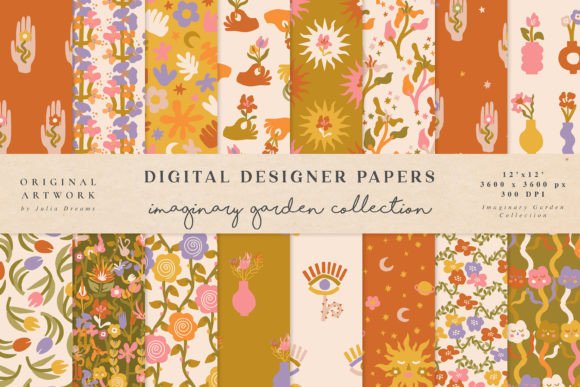
Imaginary Garden Digital Papers is a curated set of 16 hand-painted, seamless digital patterns designed for versatility and professional output. Unlike algorithmically generated or stock-style repeats, these papers reflect organic brushwork, subtle texture variation, and cohesive color harmony—qualities that emerge from intentional, tactile creation before digitization. The collection balances artistic authenticity with technical readiness: each pattern is delivered in four formats (.jpg, .png, .ai, and .eps), all at 12 × 12 inches (3600 × 3600 px, 300 dpi), making them suitable for both print and scalable vector applications.
What Sets Imaginary Garden Digital Papers Apart
The distinction lies not just in quality—but in intentionality. These aren’t mass-produced repeats optimized for algorithmic appeal. Each paper was painted by hand, then carefully scanned and refined to preserve grain, pigment bleed, and soft edge transitions. That origin shows in how the patterns behave when tiled: no visible seams, no artificial repetition fatigue, and natural variation in tone and density across the repeat unit. This matters most in large-format outputs—like wallpaper mockups, fabric swatches, or wall art prints—where synthetic uniformity can undermine visual warmth.
The inclusion of both raster and vector files adds functional flexibility. Raster files (.jpg and .png) support immediate use in photo editors, social media templates, or web-based design tools. Vector versions (.ai and .eps) allow infinite scaling without loss, critical for logo backgrounds, monogram overlays, or branding elements that may appear on business cards *and* trade show banners. Few similarly priced collections offer this dual-format consistency without requiring separate purchases or conversions.
Real-World Use Cases and Practical Fit
Imaginary Garden Digital Papers performs especially well in contexts where aesthetic cohesion and tactile nuance elevate perception. Wedding stationery designers report strong client response when using these papers as layered backgrounds for foil-stamped invitations—particularly the softer watercolor-inspired variants, which contrast elegantly with metallic finishes. Similarly, independent stationers building cohesive product lines (e.g., matching greeting cards, gift tags, and wrapping paper) find the 16-pattern scope sufficient to maintain variety without overwhelming curation effort.
For digital creators, the papers integrate smoothly into Canva, Adobe Express, and Figma workflows—especially when paired with transparent .pngs for overlay effects or .ai files for precise clipping masks. Bloggers and small-business owners use them to unify visual identity across Pinterest pins, email headers, and printable planner pages. One user noted that applying a single Imaginary Garden pattern as a subtle background layer across multiple touchpoints (website banner, Instagram story template, printable checklist) strengthened brand recognition more effectively than switching between unrelated free resources.
Comparing Approaches: Hand-Painted vs. Procedural or Stock Patterns
Digital paper libraries fall broadly into three categories: procedurally generated repeats (often via AI or tiling scripts), commercially licensed stock patterns (with usage restrictions), and hand-crafted originals like Imaginary Garden Digital Papers. Procedural options offer speed and volume but frequently lack tonal subtlety—edges may feel too crisp, colors too saturated, or textures too repetitive at close range. Stock collections vary widely in licensing clarity; some restrict commercial redistribution or require attribution, which complicates use in client deliverables like branded merchandise or packaging.
Imaginary Garden Digital Papers avoids both pitfalls: it’s human-made, with clear personal-use and commercial-use rights included, and built for adaptability—not just decoration. That said, it’s not optimized for ultra-niche needs. If you require patterns with specific cultural motifs, Pantone-matched palettes, or industry-specific symbols (e.g., medical icons or architectural line work), this collection won’t substitute for targeted illustration assets. It excels in ambient, atmospheric support—not literal or functional graphics.
Tradeoffs and Limitations to Consider
The collection’s strength—its hand-painted, cohesive aesthetic—is also its constraint. All 16 patterns share a unified sensibility: soft-edged, nature-adjacent, and gently textured. That makes it ideal for wedding brands, wellness studios, or artisanal product lines—but less suited for high-contrast branding, tech startups, or urban streetwear aesthetics. Users seeking bold geometrics, sharp linework, or industrial grunge will need to look elsewhere—or supplement selectively.
While the resolution and format coverage are robust, there’s no native SVG or PDF version included. Designers relying heavily on web-first tools (like Webflow or Framer) may need to convert .eps files manually for optimal browser rendering. Also, though seamless, the repeats are fixed at 12 × 12 inches—meaning custom scaling for non-standard dimensions (e.g., 8.5 × 11 inch letterhead) requires careful cropping or tiling adjustments rather than plug-and-play resizing.
When Imaginary Garden Digital Papers Is the Right Choice
This collection fits best when your priority is consistent, expressive texture across multiple physical and digital outputs—and when you value time saved on asset sourcing over exhaustive stylistic range. It’s particularly appropriate if you:
- Design for clients in lifestyle, hospitality, or creative services where warmth and approachability matter;
- Produce print-heavy deliverables (invitations, packaging, posters) and need reliable 300 dpi raster + scalable vector files;
- Prefer predictable licensing—no hidden restrictions on resale items like planners or stickers;
- Want to reduce visual fatigue from juggling dozens of mismatched free resources;
- Appreciate analog-informed digital assets but don’t have bandwidth to paint and scan your own.
In those scenarios, Imaginary Garden Digital Papers functions less like a “pattern pack” and more like a foundational design system—small in count, but high in coherence and reusability.
When You Might Choose Another Option
If your work demands extreme stylistic diversity—say, pairing Art Deco borders with pixel-art textures and botanical line drawings—then a modular library with hundreds of individually licensed patterns may serve better. Similarly, if you’re building a long-term brand system requiring custom color variants, animated versions, or multi-layered PSD files with editable elements, Imaginary Garden Digital Papers won’t meet those granular needs.
Also consider alternatives if budget is tightly constrained and usage is strictly personal or experimental. Many reputable free resources offer limited-use seamless patterns with clear CC-BY licenses—sufficient for blog headers or hobbyist scrapbooking, but not for client-facing print runs or commercial product lines.
Making an Informed Decision
Evaluating Imaginary Garden Digital Papers isn’t about whether it’s “the best” digital paper collection—it’s about whether its particular balance of handcrafted integrity, technical readiness, and aesthetic focus aligns with your current projects and workflow constraints. It doesn’t replace illustration, photography, or typography—but it supports them thoughtfully.
Before purchasing, ask: Do I need texture that feels handmade, not machine-generated? Will I use these across print and digital, requiring both raster and vector fidelity? Am I prioritizing cohesion over variety? If the answer to two or more is yes, Imaginary Garden Digital Papers offers tangible, time-saving value—not just pixels on a drive, but a consistent visual language already tested across real applications.