Bats-Inspired Vector Patterns for Precision Design and Seamless Repetition
Designers, educators, and production professionals increasingly turn to nature for scalable, functional motifs—and few biological forms offer the structural elegance and symbolic resonance of bats. Far from mere nocturnal curiosities, bats embody aerodynamic efficiency, fractal limb articulation, and adaptive symmetry—qualities that translate powerfully into vector-based pattern design. This article explores a specialized set of high-fidelity digital assets: three EPS 10–compatible vector patterns derived from bat morphology, each engineered for flawless tiling across large-format output. These are not decorative silhouettes or cartoonish interpretations; they are rigorously constructed, mathematically seamless repetitions optimized for professional use at print-grade resolution.
Why Seamless Vector Patterns Matter in Real-World Workflows
Seamless repetition isn’t just an aesthetic preference—it’s a functional necessity across disciplines. A textile designer preparing fabric for digital loom output must ensure no visible join lines appear at tile boundaries. An architect specifying wall cladding for a biophilic healthcare facility needs consistent rhythm across thousands of square feet. A university biology instructor creating lecture visuals requires crisp, scalable diagrams that retain clarity whether projected on a 20-foot screen or printed as a 12×12-inch handout. In each case, a poorly constructed pattern introduces visual noise, misalignment, or scaling artifacts that undermine credibility and usability.
The three included EPS files solve this by embedding true vector continuity: anchor points align precisely at tile edges, Bezier curves close without gaps or overshoots, and color definitions remain consistent across all layers. Unlike raster-based repeats—which degrade when scaled or rotated—these patterns retain infinite scalability while preserving clean edges and typographic legibility (where applicable). Each file is authored in Adobe Illustrator CC (EPS 10) and verified for backward compatibility with CS6 and newer versions, ensuring integration into legacy studio pipelines without conversion loss.
Technical Specifications: Precision Engineered for Professional Output
All assets conform to a unified technical standard designed for fidelity and interoperability:
- Dimensions: 12 × 12 inches (3600 × 3600 pixels), precisely matching standard large-format print sheet sizes and common presentation board dimensions.
- Resolution independence: Native vector construction ensures sharpness at any scale—from business card borders to building façade murals.
- DPI readiness: While vectors do not rely on DPI, the embedded raster previews and accompanying JPEGs are rendered at 300 dpi, satisfying prepress validation requirements for offset and fine-art printing.
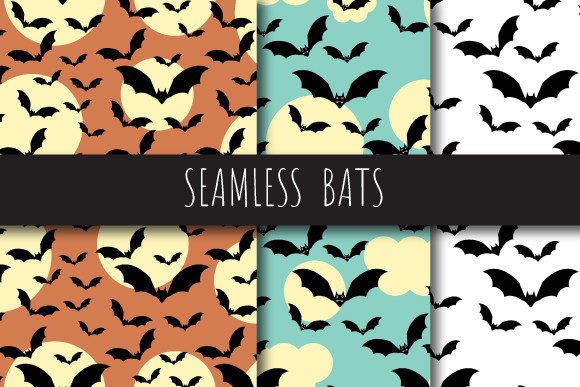
- File packaging: A single ZIP archive contains three EPS files (each representing a distinct bat-derived motif) and three corresponding high-fidelity JPEGs (RGB, sRGB color space, embedded profile) for immediate preview, web use, or CMS uploads.
This specification avoids common pitfalls: no embedded fonts (all text converted to outlines), no linked images, no transparency flattening issues, and no RGB/CMYK mismatches. Each EPS file opens cleanly in Affinity Designer, CorelDRAW, and Inkscape (with minor layer visibility adjustments), supporting cross-platform collaboration without vendor lock-in.
Three Distinct Bat-Inspired Motifs—Each with Unique Functional Strengths
The collection does not repeat a single theme with minor variations. Instead, it presents three structurally differentiated patterns—each abstracted from observable bat anatomy but developed for specific application contexts.
Motif One: Wing Membrane Lattice
Derived from the micro-vein architecture of Pteropus vampyrus, this pattern emphasizes delicate, intersecting lines that mimic collagen fiber alignment. The lattice repeats with rotational symmetry (90° increments), enabling dynamic orientation shifts without breaking continuity. Designers use it for scientific illustration backgrounds, lab report headers, or subtle branding elements where organic precision signals rigor. Because line weights taper naturally and junctions avoid acute angles, it prints crisply even at 0.25-pt stroke width—critical for technical schematics or engraved signage.
Motif Two: Forelimb Articulation Grid
This motif abstracts the skeletal kinematics of bat flight—focusing on the proportional relationships between humerus, radius, metacarpals, and phalanges. Rather than depicting bones literally, it encodes joint spacing and flexion arcs into a modular grid. Its strength lies in modularity: individual “joint cells” can be isolated, recolored, or repositioned without disrupting the overall repeat. Educators repurpose segments to annotate biomechanics lectures; product designers adapt its proportions to layout ergonomic tool handles; urban planners reference its spacing logic when configuring tactile paving intervals for accessibility compliance.
Motif Three: Echolocation Pulse Waveform
Less literal, more conceptual—this pattern translates the temporal structure of bat sonar emissions into spatial rhythm. Pulses become concentric arcs; harmonic overtones manifest as nested, non-uniform bands. The repeat unit balances density and breathing room, avoiding visual fatigue during extended viewing. It excels in data visualization contexts: mapping acoustic survey results, representing neural spike timing in neuroscience education, or serving as a non-distracting background for dashboard interfaces where clarity trumps ornamentation. Its grayscale-ready construction ensures legibility under varied lighting conditions—including low-lux clinical or laboratory environments.
Practical Integration Across User Roles
These patterns serve diverse users—not because they’re generic, but because their underlying logic supports adaptation without compromise.
- Business owners embed the Wing Membrane Lattice into branded packaging for wellness or sustainability-focused products. Its biomimetic origin reinforces natural positioning without clichéd leaf motifs—differentiating shelf presence while maintaining premium tactile expectations.
- Hobbyists and makers import the Forelimb Articulation Grid into CNC software to generate interlocking wooden puzzle pieces or laser-cut jewelry components. The predictable geometry simplifies kerf compensation and nesting calculations, reducing material waste.
- Researchers use the Echolocation Pulse Waveform as a base layer in publications illustrating sensory ecology studies. Its inherent periodicity aids reader comprehension of temporal patterns, functioning as both visual anchor and conceptual metaphor.
- Teachers project scaled-up versions during comparative anatomy units, highlighting how bat forelimbs share developmental homology with human arms—making evolutionary concepts tangible through proportional repetition rather than static diagrams.
Implementation Considerations Beyond Aesthetics
Adopting seamless vector patterns requires attention to context—not just compatibility. Here are field-tested observations:
- Color mode discipline matters. While the EPS files contain no embedded profiles, the JPEG previews are sRGB. For CMYK print jobs, assign the appropriate working space *after* opening the EPS—not before—and verify spot color usage if applying Pantone references.
- Tile size affects perception. At 12×12 inches, these patterns suit wall graphics or exhibition panels. For apparel, consider scaling down the repeat unit in Illustrator’s “Pattern Options” panel—avoiding pixelation that would occur if resizing the JPEGs instead.
- Accessibility isn’t optional. When using the Echolocation Pulse Waveform as a background for text, maintain a minimum contrast ratio of 4.5:1 against foreground type. Its waveform density can reduce readability if paired with light gray text on mid-tone backgrounds—test with browser-based contrast checkers before finalizing layouts.
- Copyright clarity is built-in. These are original vector constructions—not traced photographs or AI-generated composites. They carry no third-party IP entanglements, making them safe for commercial derivative works, including NFT-based art editions or open educational resources (OER).
How These Assets Reflect Evolving Design Ethics
In an era where algorithmic pattern generation floods marketplaces with superficially similar outputs, these bat-derived vectors represent intentional design stewardship. Each curve was adjusted by hand to honor anatomical plausibility—not just visual novelty. The decision to limit the collection to three motifs reflects curation over volume: depth of utility over breadth of decoration. That restraint serves users who value predictability, documentation, and long-term maintainability—qualities often missing in bulk-download libraries.
Moreover, grounding abstraction in real biological systems invites deeper engagement. A student recognizing the wing membrane lattice as a stylized version of actual bat physiology is more likely to explore chiropteran conservation challenges. A manufacturer selecting the Forelimb Articulation Grid for industrial design may later investigate how bat-inspired morphologies inform energy-efficient drone development. The patterns don’t just fill space—they seed inquiry.
Final Notes on Scalability and Future-Proofing
Vector formats evolve—but EPS 10 remains the most widely supported interchange standard across commercial print, architectural visualization, and academic publishing workflows. By avoiding newer features like variable fonts or 3D effects, these files prioritize longevity over trendiness. They will open in software released a decade from now as readily as they do today.
That durability extends to conceptual relevance. Bats continue to inspire breakthroughs—from ultrasound imaging advancements to sustainable materials science. As research deepens, these foundational patterns provide a stable visual vocabulary. They are not static relics, but living references: precise, adaptable, and rooted in observable reality. Whether used to visualize ecological connectivity, reinforce brand values tied to resilience and adaptation, or simply bring quiet sophistication to a conference backdrop, they operate with integrity at every scale—just as the bats themselves do in the ecosystems they inhabit.