Abstract Shape and Pattern Vector Pack: A Practical Look for Designers and Creators
Designers, educators, small business owners, and DIY creators often need versatile, high-quality visual assets that balance charm with functionality. The Abstract Shape and Pattern Vector Pack fits into this space as a curated collection of playful, cartoony-style graphics — specifically designed for flexibility across both digital and print applications. Unlike generically styled pattern libraries or overly minimal vector sets, this pack emphasizes intentional cuteness without sacrificing technical readiness: all files are delivered in standard professional formats, at 2000 × 2000 px resolution and 300 dpi, with transparent backgrounds and seamless tiling built-in.
What Sets This Pack Apart?
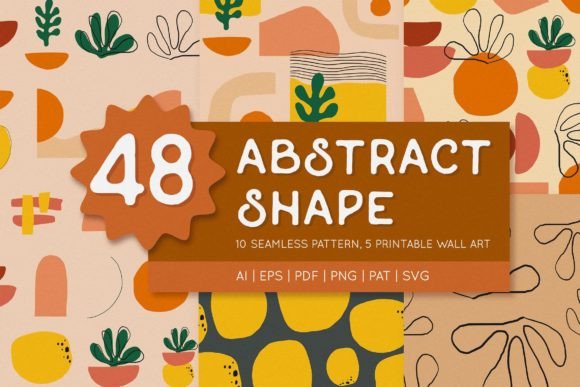
The Abstract Shape and Pattern Vector Pack includes three distinct but complementary components: 10 seamless patterns in PAT format (compatible with Adobe Photoshop), 10 tileable PNGs (ideal for quick drag-and-drop use in Canva, Figma, or web builders), and 5 printable wall art vector files in AI, EPS, and JPG. That combination reflects a thoughtful approach to real-world workflow diversity — not every user works in Photoshop, and not every project starts from scratch in Illustrator.
Each pattern is drawn in a light, friendly cartoon aesthetic: soft edges, rounded forms, gentle curves, and balanced negative space. Because the shapes are abstract — think bubbly blobs, wobbly stars, squishy hearts, and asymmetrical loops — they avoid literal associations while still feeling warm and inviting. That abstraction supports broader reuse: a pattern that reads as “playful” rather than “baby-themed” or “kawaii-only” stays relevant across age groups and contexts.
Transparency is baked in. Every PNG and vector file uses alpha channels, meaning users can drop them onto any background color or gradient without clipping or white halos. This matters most when layering over photos, applying to fabric mockups, or designing social media posts where background tone shifts frequently.
How It Compares With Other Pattern and Vector Options
Many pattern packs fall into one of two categories: highly detailed, photorealistic repeats (often heavy on texture and shadow) or ultra-minimal geometric arrangements (clean lines, strict symmetry, muted palettes). The Abstract Shape and Pattern Vector Pack occupies a middle ground — expressive but not chaotic, structured but not rigid. It’s closer in spirit to hand-drawn illustration libraries than algorithmically generated tessellations.
Compared to free pattern resources, this pack offers consistency in scale, spacing, and line weight across all 10 designs. Free tiles often vary in resolution, repeat behavior, or transparency handling — leading to visible seams or inconsistent sizing when scaled. Here, each seamless pattern has been tested for true tileability at multiple zoom levels and exported with identical pixel alignment.
When weighed against full design subscription services (like Creative Market bundles or Envato Elements), the Abstract Shape and Pattern Vector Pack trades breadth for focus. Subscriptions offer thousands of assets across dozens of styles; this pack delivers fewer items but with tighter cohesion and more intentional stylistic continuity. For someone building a cohesive brand identity — say, a children’s educational blog, a boutique stationery line, or a wellness workshop series — that consistency can reduce decision fatigue and speed up layout work.
Practical Use Cases and Real-World Fit
This pack shines where warmth and approachability matter, but professionalism and scalability remain essential. Consider these examples:
- Greeting cards and invitations: Layer a subtle tileable pattern behind text, or use it as a border frame. The 300 dpi resolution ensures crisp printing even on thick cardstock.
- Educational materials: Teachers creating worksheets or classroom posters benefit from non-distracting yet engaging backgrounds — especially for younger learners or neurodiverse students who respond well to soft, rhythmic visuals.
- Digital content: Blog headers, social media banners, and email newsletter dividers gain visual interest without competing with copy. The square format (2000 × 2000 px) adapts easily to Instagram posts, Pinterest pins, or website hero sections via cropping or scaling.
- Textile and product design: Because patterns are truly seamless and vector-based, they scale cleanly for fabric printing, tote bags, or sticker sheets — no pixelation or misaligned repeats.
It’s less ideal for projects requiring photorealism, strict corporate branding (e.g., law firm brochures), or highly technical illustrations (like architectural schematics or infographics with precise data mapping). The style is intentionally emotive and informal — an asset in some contexts, a mismatch in others.
Format Considerations and Workflow Compatibility
The inclusion of PAT files is notable. While many designers default to PNGs for simplicity, PAT files preserve native tiling behavior inside Photoshop — allowing real-time resizing, color overlay adjustments, and blending mode experimentation without flattening layers. That’s valuable for iterative design work, especially when testing how a pattern interacts with typography or photography.
The wall art files (AI/EPS/JPG) serve dual purposes: as ready-to-print decor *and* as editable starting points. In Illustrator, users can recolor individual shapes, adjust spacing, or isolate elements for custom compositions. The JPG versions provide immediate usability for platforms that don’t support vector uploads — like certain e-commerce site builders or presentation tools.
One limitation worth noting: the pack doesn’t include SVG exports. While AI and EPS cover most vector editing needs, SVG is preferred for responsive web use (e.g., animated backgrounds or icon integration). Users needing SVG would need to convert manually — a minor extra step, but one that affects front-end developers or web designers prioritizing lightweight, scalable assets.
When It Makes Sense — and When It Might Not
The Abstract Shape and Pattern Vector Pack is a strong choice if you value:
- Stylistic unity across multiple deliverables,
- Ready-to-use transparency and tiling without post-processing,
- A lighthearted but polished aesthetic suitable for inclusive, audience-friendly communication,
- Files that function equally well in print production and digital publishing pipelines.
It may be less suitable if your work demands:
- Highly specific cultural motifs or thematic precision (e.g., botanical, nautical, or vintage motifs),
- Dynamic or interactive elements (like animated GIFs or Lottie files),
- Extensive color variants out-of-the-box (though recoloring vectors is straightforward),
- Full design system support (typography pairings, UI kits, or component libraries).
For those evaluating alternatives, consider whether your priority lies in speed (ready-made assets), adaptability (editable vectors), or stylistic range (multiple moods or themes). The Abstract Shape and Pattern Vector Pack leans decisively toward speed and adaptability — within a clearly defined visual lane.
Making a Thoughtful Choice
No single resource solves every design challenge. What makes the Abstract Shape and Pattern Vector Pack useful isn’t just its contents — it’s the intention behind them. The square format, consistent DPI, transparent layers, and blend of PAT/PNG/AI/EPS files reflect awareness of how people actually work: switching between tools, balancing deadlines with quality, and needing assets that behave predictably across contexts.
If your current process involves stitching together mismatched free downloads, manually adjusting repeats, or over-editing generic templates to feel personal, this pack offers a measured alternative — not flashy, not exhaustive, but quietly capable. And sometimes, that’s exactly what moves a project forward.