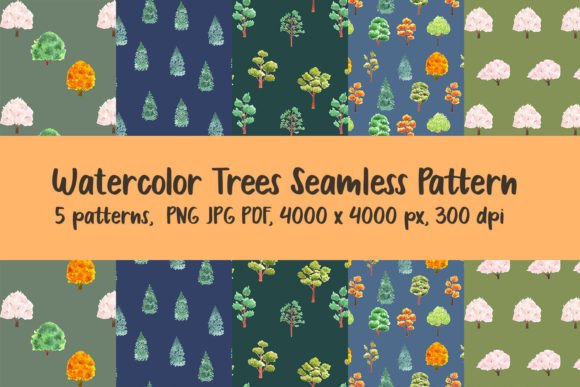
Watercolor Trees Leaves Seamless Pattern: A Practical Asset for Designers and Makers
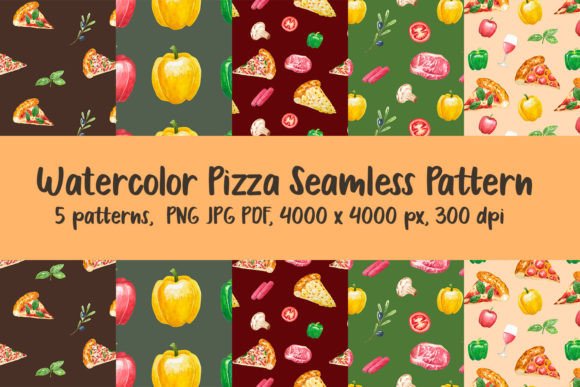
Watercolor Trees Leaves Seamless Pattern is a hand-painted digital resource designed for real-world application—not just visual appeal. It’s part of a curated set of five seamless patterns, each delivered in PNG, JPG, and PDF formats at 300 dpi and 4000 × 4000 px resolution. This isn’t decorative filler; it’s a production-ready component that fits into specific stages of design, marketing, and product development workflows—where consistency, scalability, and tactile authenticity matter.
Where It Fits in the Creative Process
Unlike generic stock graphics, Watercolor Trees Leaves Seamless Pattern functions as a bridge between concept and execution. Before a project begins, it helps define tone and texture—especially when branding or seasonal campaigns call for organic warmth without photographic rigidity. During layout or mockup phases, it replaces placeholder gradients or low-res repeats, letting designers test scale, color harmony, and print fidelity early. After finalization, it moves directly into production: whether applied to fabric rolls, printed on kraft paper wraps, or embedded into editable invitation templates.
This pattern doesn’t wait for “inspiration.” It responds to constraints—tight deadlines, client revisions, material limitations—and delivers predictable output. Its hand-painted origin means subtle variation in pigment bleed and edge softness, but its seamless tiling ensures no visible breaks across large surfaces. That balance—human texture with technical reliability—is what makes it usable across both analog and digital pipelines.
Integration Across Tools and Platforms
Compatibility starts with format flexibility. PNG files retain transparency for layering over photos or illustrations in Photoshop or Figma. JPGs load quickly in email templates or CMS-based marketing tools like Mailchimp or Squarespace. PDFs support vector-like scaling in Adobe InDesign or Illustrator—critical when resizing for banners, packaging dielines, or multi-page menus.
For fabric printers, the 4000 × 4000 px dimension aligns with standard repeat tile requirements for roll-fed textile printing. For greeting card publishers, the 300 dpi resolution meets offset press specifications without upscaling artifacts. Even educators using Canva for classroom materials benefit: uploading the PNG lets them apply the pattern to custom worksheets or presentation backgrounds while maintaining clarity on projector displays.
No plugin, license key, or cloud sync is required. It’s a local asset—download once, store in an organized folder (e.g., /Assets/Patterns/Watercolor_Trees_Leaves/), and reference across projects. That simplicity reduces friction when switching between Adobe Suite, Affinity apps, or open-source tools like GIMP or Scribus.
Practical Use Cases—Beyond Decoration
Fabric printing: Apply the Watercolor Trees Leaves Seamless Pattern to apparel or home goods using Spoonflower or Printful. Because the repeat is truly seamless and resolution-matched, you avoid costly reprints due to misaligned tiles or pixelation along seam lines. Test a 12" × 12" swatch first—this confirms how watercolor softness translates to cotton twill or linen blend textures.
Menu and stationery design: Restaurants updating seasonal menus often need cohesive visual language across digital and print touchpoints. Overlay the pattern at 8–12% opacity behind menu text in InDesign. Its organic rhythm supports readability while reinforcing a farm-to-table or botanical theme—no need to commission custom illustration for every revision cycle.
Promotional merchandise: When producing limited-run tote bags or notebooks for a workshop or launch, this pattern provides instant brand cohesion. Pair it with a clean sans-serif logo and one accent color—then export assets for vendors in CMYK JPG (for screen printing) or RGB PNG (for direct-to-garment). The hand-painted quality signals craftsmanship, which resonates with audiences valuing authenticity over polish.
Greeting and invitation cards: Unlike rigid geometric repeats, watercolor textures adapt gracefully to irregular shapes. Use clipping masks in Illustrator to wrap the pattern around floral motifs or curved borders. For letterpress or foil-stamped invitations, supply the vendor with the PDF version—it preserves edge integrity better than raster exports during prepress conversion.
Workflow Efficiency and Quality Control
Preparation matters. Before applying Watercolor Trees Leaves Seamless Pattern to any deliverable, verify color mode: RGB for web and screen use, CMYK for commercial print. If your workflow includes Pantone matching (e.g., for branded stationery), sample the pattern against your brand palette in a neutral lighting environment—not just on screen—to assess pigment warmth and contrast.
Organization prevents version drift. Name files clearly: Watercolor_Trees_Leaves_Seamless_PNG_RGB_4000x4000.png. Store backups in two locations—one local, one encrypted cloud (e.g., Backblaze or Dropbox with version history). That avoids last-minute scrambles when a client requests a TIFF export or needs the pattern adjusted for a non-standard aspect ratio.
Efficiency gains compound over time. Once you’ve built a library of compatible assets—like coordinating fonts, icon sets, or photo overlays—you reduce decision fatigue. Instead of searching for “nature background” before every project, you open your Patterns folder and select based on context: Watercolor Trees Leaves Seamless Pattern for softness and movement, Watercolor Trees Seamless Pattern for stronger vertical rhythm and trunk definition.
How It Complements Other Resources
This pattern works best when treated as one element in a system—not a standalone solution. Pair it with muted earth-tone palettes (e.g., #5D734C, #A6B99A) for consistent mood. Use it alongside hand-drawn line art (not photorealistic vectors) to maintain stylistic continuity. If sourcing photography for the same campaign, choose images with shallow depth of field and natural light—avoiding high-contrast studio shots that clash with the pattern’s gentle diffusion.
It also interfaces well with collaborative tools. Share the PNG file via Google Drive with copywriters who need to visualize how body text flows over texture. Embed the PDF in Notion documentation for your design team so usage guidelines (e.g., “max 15% opacity on dark backgrounds”) stay attached to the asset itself.
Long-Term Usability Considerations
Because it’s hand-painted—not algorithmically generated—the Watercolor Trees Leaves Seamless Pattern avoids trend fatigue. It won’t look dated next year the way overused AI-generated foliage might. Its longevity comes from restraint: limited color variance, intentional negative space, and emphasis on shape over detail. That makes it adaptable across industries—from wellness coaching brands to boutique wineries—without requiring visual reinterpretation.
Test durability by using it across three distinct outputs within one quarter: a printed product label, a social media carousel background, and a physical workshop handout. Note where adjustments were needed (e.g., brightness boost for Instagram, contrast reduction for newsprint). Document those tweaks in a simple spreadsheet—this becomes your internal style guide for future pattern use.
Finally, consider licensing scope. Since it’s royalty-free for commercial use, you can apply it across client work without renegotiating rights per project—provided you’re not reselling the pattern itself as a standalone product. That clarity removes legal overhead from freelance proposals or agency estimates.
Watercolor Trees Leaves Seamless Pattern earns its place in your toolkit not by being everywhere, but by solving specific, recurring problems: bridging digital precision with organic warmth, supporting fast iteration without sacrificing quality, and delivering consistency across physical and digital outputs—all from a single, well-executed file.