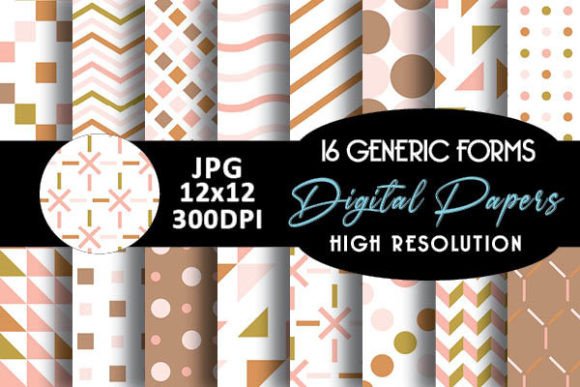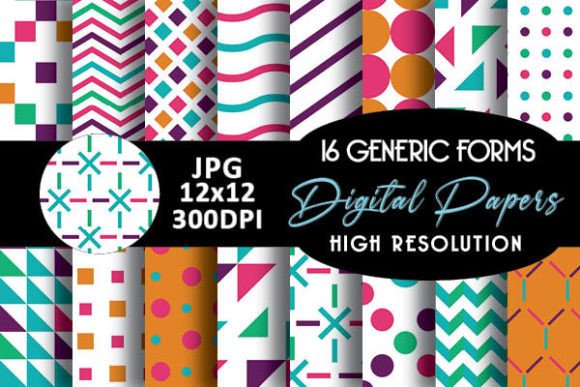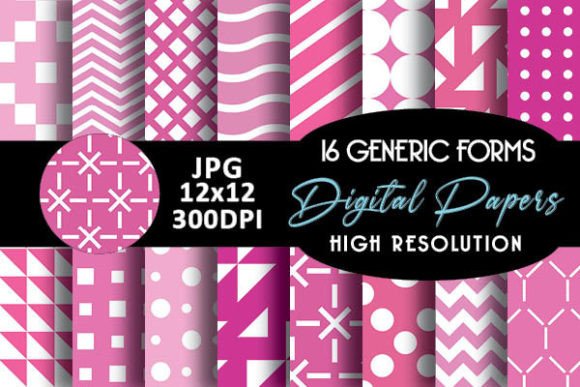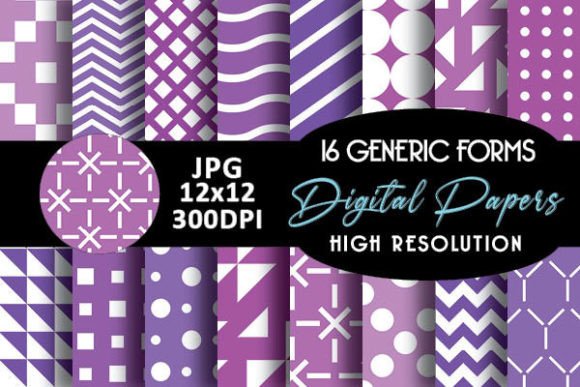
Mint Geometric Shapes Digital Papers
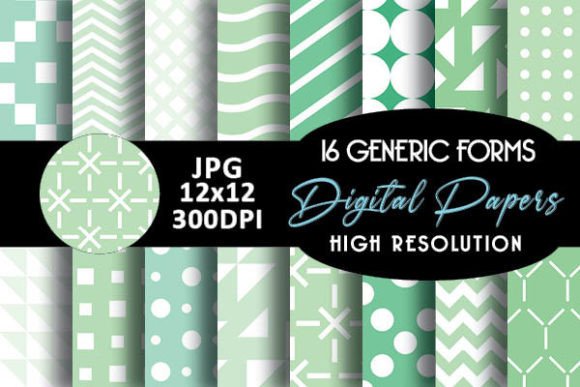
Geometric digital papers are more than decorative backgrounds—they’re functional assets that support consistency, speed, and visual cohesion across creative and professional workflows. Mint Geometric Shapes Digital Papers is a curated set of 16 high-resolution, generic geometric pattern files designed for immediate integration into real-world projects. Each paper features clean lines, balanced proportions, and a soft mint tone that bridges modern minimalism with approachable warmth—making them especially effective for branding, communication, and hands-on making.
Where These Digital Papers Fit in Your Workflow
Unlike one-off graphics or trend-dependent templates, Mint Geometric Shapes Digital Papers function as foundational layers—not final outputs. They sit early in the asset pipeline: selected before layout begins, applied during design iteration, and retained as reusable components for future versions. For example, a small business owner preparing a quarterly newsletter might choose one of these papers as the base layer for an email banner, then reuse the same pattern (scaled or recolored) in a matching PDF report cover and printed workshop handout. That continuity isn’t accidental—it’s enabled by having a consistent, editable, and platform-agnostic background resource on hand.
For educators building lesson materials or freelancers assembling client pitch decks, these papers reduce decision fatigue. Instead of searching for “safe” patterns mid-project—or worse, defaulting to overused stock textures—you open your organized assets folder and select from 16 coordinated options. That saves time, preserves brand alignment, and keeps focus on content rather than ornamentation.
Practical Use Cases Across Roles
The versatility of Mint Geometric Shapes Digital Papers becomes clear when mapped to specific tasks:
- Scrapbookers and crafters use them as printable bases for custom cards, journal inserts, or layered collage elements—especially effective when cut with precision die-cut machines or printed on textured cardstock.
- Marketers and small business owners apply them to social media banners, Canva presentations, and downloadable lead magnets without needing design expertise—simply drag, drop, and overlay text with sufficient contrast.
- Bloggers and content creators embed them in Pinterest pins, ebook chapter dividers, or printable checklists where subtle geometry adds structure without competing with information.
- Teachers and trainers integrate them into slide decks, handouts, and student worksheets to signal section breaks or reinforce thematic units—geometry subtly cues organization and logic.
- Freelance designers use them as non-destructive background layers in Photoshop or Illustrator, adjusting opacity, blending modes, or clipping masks to match client brand palettes while retaining full editability.
Compatibility and Technical Readiness
All 16 files are delivered as high-resolution JPEGs (300 DPI, 12×12 inches), ensuring print clarity and digital scalability. No proprietary software is required—these work natively in Adobe Creative Cloud apps, Canva, Affinity Suite, Google Slides, Microsoft PowerPoint, and even basic image editors like Preview or Paint.NET. Because they’re raster-based (not vector), they load quickly and render consistently across devices and platforms—critical when collaborating with clients or team members who use different tools.
For users working in vector-heavy environments, a simple workaround maintains flexibility: place the JPEG as a locked background layer, then build scalable text and icons above it. This preserves sharpness at any size while keeping the geometric texture grounded and intentional—not stretched or pixelated.
Organizing for Long-Term Usability
One of the most overlooked aspects of digital asset management is naming and categorization. To get consistent value from Mint Geometric Shapes Digital Papers, rename files descriptively—e.g., mint-geometric-diamonds-soft.jpg instead of paper_07.jpg. Store them in a dedicated “Textures & Backgrounds” subfolder inside your master “Design Assets” directory. Add them to your cloud-synced library (Dropbox, Google Drive, or Creative Cloud Libraries) so they’re accessible whether you’re designing on a desktop, editing on a tablet, or prepping assets remotely.
Consider creating a quick-reference PDF thumbnail sheet—six to eight patterns per page with filenames and brief usage notes (e.g., “Best for light text overlays” or “Works well with sans-serif headings”). Keep this file open alongside your main project window during early layout phases. It turns selection from guesswork into an intentional, repeatable step.
Integration With Other Tools and Systems
Mint Geometric Shapes Digital Papers don’t exist in isolation—they gain utility through connection. Pair them with:
- Color palette tools like Coolors or Adobe Color to extract complementary accent hues from the mint base, ensuring typography and icons harmonize visually.
- Typography pairings—clean sans-serifs (Inter, Montserrat, Poppins) and structured serifs (Cormorant Garamond, Playfair Display) both complement the precision of geometric forms without visual conflict.
- Project management systems—tag relevant tasks in Notion or ClickUp with “#background” or “#print-ready” and attach the appropriate paper file directly to the task, linking asset use to deliverables.
- Print-on-demand services—upload files directly to platforms like Printful or Gelato for custom notebooks, greeting cards, or wall art. Their resolution and color profile meet standard production requirements out of the box.
Quality Control and Consistency Checks
Before finalizing any output using these papers, run three quick checks:
- Contrast test: Overlay your intended text at 100% opacity and verify readability against the pattern—especially important for light-on-light combinations.
- Scale verification: Zoom to 100% in your editor and confirm no unintended pixelation or moiré effects appear at common export sizes (e.g., Instagram post 1080×1080, A4 PDF).
- Version alignment: If reusing a paper across multiple documents, ensure all instances use the exact same file—not a renamed copy or resized derivative—to avoid subtle inconsistencies in tone or sharpness.
These checks take under 90 seconds but prevent revisions, client feedback loops, or last-minute reprints.
Efficiency Gains Over Time
What makes Mint Geometric Shapes Digital Papers valuable beyond individual projects is their compound utility. Each time you use one, you reinforce a visual language. After five uses across different contexts—say, a birthday invitation, a workshop agenda, a product spec sheet, a blog sidebar graphic, and a printed thank-you card—you’ve built recognizable coherence without repeating identical layouts. That’s not branding by accident; it’s branding by intention, supported by reusable, quality-controlled assets.
For freelancers billing by the hour, reducing background selection and customization time by even two minutes per project adds up to nearly 17 hours saved annually across 50 client files. For educators, it means more time refining learning objectives instead of troubleshooting layout alignment. For hobbyists, it means less friction between idea and execution—so creativity flows without technical interruption.
Getting Started Without Overcomplication
You don’t need a full redesign or workflow overhaul to begin using Mint Geometric Shapes Digital Papers. Start with one current project where visual consistency matters—a recurring email template, a series of social posts, or a set of printable planner pages. Pick one pattern that matches your existing color scheme or mood. Apply it. Evaluate how it affects hierarchy, tone, and perceived professionalism. Then adjust—swap contrast, add a subtle shadow to text, or try a different blend mode. Iterate once, not ten times.
That first use anchors the asset in your process. From there, expansion happens naturally: adding another pattern for variation, saving a version with your logo watermark for branded collateral, or sharing a favorite with a collaborator who asks, “Where did you get that background?”
Because these papers are generic in pattern but distinct in tone, they adapt—not dictate. They support your voice, your goals, and your timeline. And when implementation feels effortless, what remains is clarity, confidence, and forward motion.