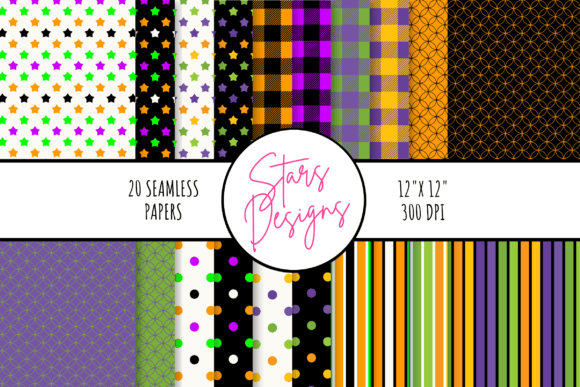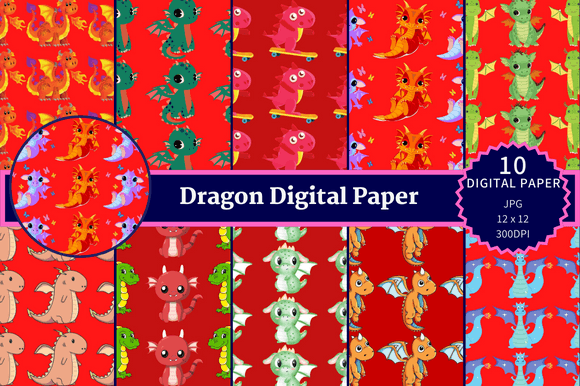
Dragon Halloween Digital Paper Backgrounds
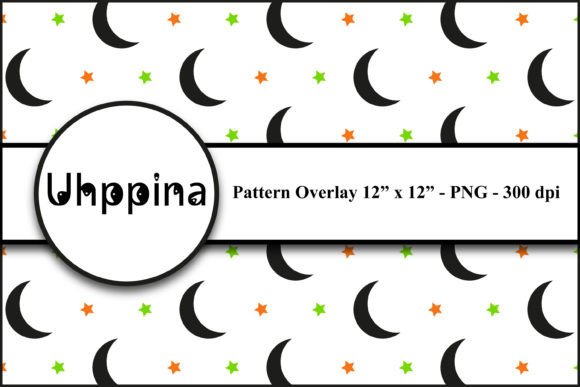
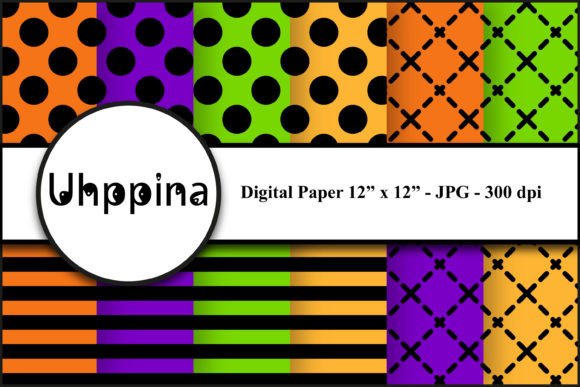
Dragon refers to a curated collection of 10 Halloween-themed digital paper backgrounds, designed for versatility and creative reuse. These are not illustrations or standalone graphics, but seamless, high-resolution pattern files—each measuring 12×12 inches (3600×3600 pixels) at 300 DPI in JPG format. The patterns feature cohesive Halloween motifs—such as bats, pumpkins, skulls, cobwebs, and gothic florals—rendered with consistent color palettes and balanced repetition to support professional printing and layered digital design.
Why Consider Dragon for Creative Projects?
Designers, crafters, educators, and small-business owners often seek reliable, ready-to-use assets that reduce time spent on layout preparation without sacrificing visual quality. Dragon addresses this need by offering pre-sized, print-ready patterns optimized for common creative workflows. Its appeal lies less in novelty and more in functional consistency: each file is tested for seamlessness, scaled appropriately for standard scrapbook pages and invitation templates, and delivered in a widely compatible format.
Users evaluating Dragon typically prioritize predictability—knowing a pattern will tile cleanly across a full-page background, hold detail when printed at scale, and integrate smoothly into tools like Adobe Photoshop, Canva, or Cricut Design Space. Unlike generative AI outputs or free web resources, Dragon provides controlled variables: fixed dimensions, uniform resolution, and intentional thematic cohesion.
Key Benefits and Practical Advantages
Dragon delivers several measurable advantages for users with defined production requirements:
- Print-readiness: At 300 DPI and 12×12 inches, each file supports crisp physical output—ideal for printed invitations, scrapbook layouts, or handmade cards where pixelation or scaling artifacts would undermine professionalism.
- Workflow efficiency: Seamless tiling eliminates the need for manual alignment or blending when extending backgrounds beyond a single tile, saving time in both digital editing and physical cutting processes.
- Cross-purpose utility: Though themed for Halloween, the patterns avoid overly literal or seasonal clichés—many rely on texture, tone-on-tone contrast, or stylized line work, making them adaptable for fall birthdays, classroom decorations, or even editorial layouts requiring subtle thematic resonance.
- Format reliability: JPG delivery ensures broad software compatibility without requiring specialized viewers or converters—a practical consideration for users working across platforms or with limited technical support.
Tradeoffs and Realistic Expectations
Dragon is purpose-built—not a comprehensive design suite. It does not include editable vector files, alternate colorways, or layered PSD versions. Users seeking customization options such as recoloring individual elements or adjusting motif density will need to apply post-download edits using raster-based tools. Similarly, because the pack contains only JPGs, transparency is not supported; overlays or cutouts require additional masking steps.
Resolution and dimension are fixed. While 3600×3600 pixels accommodates most standard uses, projects requiring ultra-large-format printing (e.g., banners over 24 inches wide) may necessitate upscaling—introducing potential softness unless handled with appropriate interpolation methods. Also, the Halloween theme, while flexible, imposes natural boundaries: it’s less suitable for year-round branding or non-seasonal events unless used abstractly (e.g., as textural underlays).
When Dragon Is a Strong Fit
Dragon aligns well with users who have clear, repeatable production goals and value consistency over customization. It is especially useful for:
- Small-batch crafters producing physical goods—such as hand-assembled greeting cards or gift tags—who need dependable, printable backdrops without licensing ambiguity.
- Educators preparing themed classroom materials (e.g., Halloween reading logs, reward certificates) and requiring quick, copyright-cleared assets for internal use.
- Independent stationery designers building seasonal product lines and needing cohesive background textures to unify collections without designing from scratch.
- Bloggers or content creators developing Pinterest-optimized printable kits, where uniform sizing and resolution simplify user download and printing experiences.
In these contexts, Dragon reduces decision fatigue and iteration time. Its strength lies in narrowing scope—not expanding it.
When Alternatives May Be More Appropriate
Dragon is less optimal when project requirements emphasize flexibility, scalability, or long-term asset management. Consider alternatives if you:
- Need transparent PNGs for digital overlays or web use—JPGs lack alpha channels, limiting layering options in presentation tools or social media graphics.
- Work primarily with vector-based applications (e.g., Illustrator, Silhouette Studio) and require scalable, resolution-independent elements for precise cutting or resizing.
- Require commercial redistribution rights beyond end-product use—for example, bundling backgrounds into a paid template kit for resale. License terms should be verified separately, as Dragon’s usage rights are typically limited to personal and small-business end products.
- Prefer modular design systems—such as separate motif files, swatches, or SVG icons—that allow recomposition rather than relying on fixed pattern layouts.
Making an Informed Decision
Evaluating Dragon begins with clarifying your primary use case. Ask: Will the final output be printed or digital? Does the project demand exact sizing, or is adaptability more important? How much time can you allocate to post-processing versus using assets “as-is”?
If your workflow prioritizes speed, predictability, and physical output—and you’re comfortable working within a defined theme and fixed raster format—Dragon offers tangible efficiency gains. Its value isn’t in breadth but in execution fidelity: every file meets a narrow set of technical benchmarks so users can focus on composition and content rather than troubleshooting resolution mismatches or tiling gaps.
Conversely, if your projects regularly involve multi-format delivery (web + print), frequent color adjustments, or collaborative editing across teams with mixed software access, a broader toolkit—including vector pattern libraries or subscription-based asset services—may provide more sustainable flexibility over time.
Ultimately, Dragon serves a specific niche: the practitioner who values precision over possibility, and repeatability over reinvention. It reflects a pragmatic approach to digital resource selection—one grounded in real-world constraints rather than theoretical capability.