Halloween Moon Star Overlay: A Transparent Digital Paper for Creative Versatility
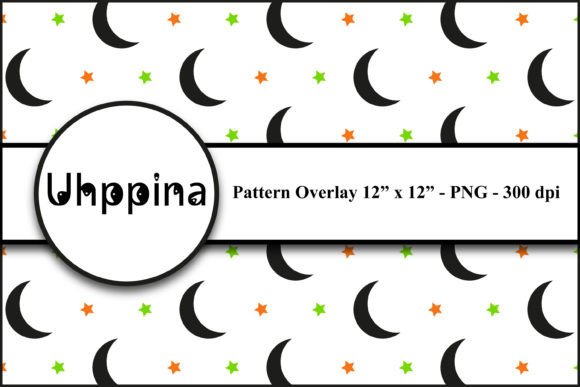
When designing for seasonal projects—especially those rooted in the atmospheric charm of Halloween—precision, flexibility, and visual fidelity matter. The 1 Overlay Halloween Moon Star is not merely a decorative element; it’s a purpose-built digital asset engineered for creators who demand both aesthetic cohesion and technical reliability. This transparent seamless paper functions as a layered design component, allowing users to place its hauntingly elegant moon-and-star motif over any background color or texture they choose—without clipping, distortion, or loss of detail.
What Makes This Overlay Technically Distinctive?
At its core, the 1 Overlay Halloween Moon Star is delivered as a high-resolution PNG file—300 dpi, 12 × 12 inches (30.48 × 30.48 cm)—ensuring crisp reproduction across physical and digital outputs. Unlike JPEGs or low-res graphics, PNG format preserves full alpha-channel transparency, meaning no white or black background interferes with layering. This transparency isn’t simulated—it’s native, enabling true compositing in tools like Adobe Photoshop, Canva, Affinity Designer, or even basic photo editors that support layers.
The seamless nature of the pattern means it tiles without visible breaks. While this particular overlay is a single motif rather than a repeating tile, its edge-to-edge transparency and balanced negative space allow it to sit naturally on gradients, textures, photos, or solid-color backgrounds—whether deep plum, charcoal gray, burnt orange, or matte black. Designers can scale it proportionally within layout constraints without pixelation, thanks to its vector-friendly raster resolution.
Practical Applications Across Diverse Creative Domains
Creatives don’t operate in silos—and neither should their assets. The 1 Overlay Halloween Moon Star bridges disciplines through adaptability:
- Sublimation Printing: Because it’s 300 dpi and transparent, the overlay integrates cleanly into sublimation workflows. When placed over a base design—say, a ghost-shaped silhouette on a black t-shirt mockup—the moon-and-star motif appears to float above the surface, adding depth without requiring additional cut layers or registration alignment.
- Scrapbooking & Paper Crafting: Digital scrapbookers use overlays like this to add subtle thematic emphasis. Printed onto premium cardstock or vellum, then layered physically over photos or journaling blocks, the motif reinforces mood without overwhelming composition. Its transparency ensures underlying text remains legible.
- Invitations & Event Branding: Whether designing for a haunted house fundraiser, classroom party, or boutique bakery’s October launch, the overlay serves as a unifying visual thread. Applied consistently across save-the-dates, menus, and signage—even at varying sizes—it establishes continuity without repetitive rigidity.
- Educational Materials: Teachers building Halloween-themed literacy units or science lessons about lunar phases can embed the overlay into worksheets or interactive slides. Its clarity at small sizes supports readability, while its thematic resonance sustains student engagement.
- Small Business Marketing: Local bakeries printing cupcake wrappers, indie bookstores designing window clings, or print-on-demand shops curating seasonal collections all benefit from a consistent, licensable, production-ready asset. No attribution required; no licensing ambiguity.
Why Transparency + Resolution = Real-World Reliability
Many Halloween graphics are offered as opaque JPGs or low-resolution web images. That works for social media posts—but fails dramatically when translated to physical output. A 72 dpi image stretched across a 12-inch square becomes visibly jagged. A non-transparent PNG forces manual background removal, introducing halos or fringing around delicate star points.
In contrast, the 1 Overlay Halloween Moon Star eliminates these friction points. Its transparency means designers spend seconds—not minutes—positioning it. Its resolution ensures fidelity whether printed on a home inkjet, commercial offset press, or dye-sublimation printer. And because it’s delivered in a compressed .zip folder containing only the essential file, there’s no bloat, no unnecessary variants, and no confusion about which version to use.
Color Consistency: Managing Expectations Across Devices and Outputs
This is where technical awareness meets practical execution. The product description rightly notes that “there may be color variation depending on your monitor, cell phone screen, tablet, printer configuration and or the type of paper used.” That’s not a limitation—it’s an acknowledgment of real-world variables. Monitors vary in gamma, brightness, and color profile calibration. Inkjet printers render blacks differently than laser printers. Matte paper absorbs ink differently than glossy or sublimation-coated substrates.
That’s why the guidance to “do a test print beforehand” is not boilerplate—it’s foundational practice. A test print reveals how the overlay interacts with your specific paper stock, ink saturation, and lighting conditions. It also exposes whether your editing software is applying unintended color management—such as converting sRGB to CMYK without previewing gamut shifts. For professionals managing client deliverables, this step prevents costly reprints and misaligned expectations.
User-Centered Workflow Integration
How does the 1 Overlay Halloween Moon Star fit into daily creative routines? Consider three common scenarios:
- The Educator Prepping a Unit: Downloads the .zip, extracts the PNG, drags it into Google Slides. Sets blend mode to “Multiply” over a navy-blue title slide. Adds student names beneath—no background erasing needed. Prints 30 copies—all retain motif clarity.
- The Sublimation Entrepreneur: Imports the overlay into Sawgrass Creative Studio. Places it atop a pre-sized tumbler template. Adjusts opacity to 85% for subtlety. Sends to printer—knowing the 300 dpi resolution matches the machine’s native output capability.
- The DIY Party Planner: Opens the file in Canva, uploads it as a custom element, and layers it over a photo of homemade cookies. Uses Canva’s background remover (unnecessary, but harmless) before realizing the transparency already handles it—then deletes the extra step and proceeds.
In each case, the overlay reduces decision fatigue. There’s no need to source fonts that “match” Halloween, no hunting for compatible stars, no wrestling with clipping masks. The design intent is baked in—yet the execution remains fully user-directed.
Design Philosophy Embedded in Functionality
Good digital paper doesn’t shout. It supports. The 1 Overlay Halloween Moon Star exemplifies restrained thematic design: the crescent moon is stylized but recognizable; stars vary subtly in size and spacing to avoid mechanical repetition; negative space dominates, ensuring breathability in dense layouts. It avoids clichés like pumpkins, bats, or cobwebs—making it equally appropriate for sophisticated adult gatherings, literary events, or astronomy-themed classrooms.
This intentional minimalism extends to delivery. One pattern. One format. One size. No upsells. No “premium versions” locked behind paywalls. Just a single, well-executed asset—optimized for reuse, redistribution, and reinterpretation. That simplicity reflects deeper understanding: creators don’t need more options—they need fewer obstacles between idea and realization.
Compatibility Notes for Technical Users
While the overlay is format-agnostic in function, certain technical considerations enhance longevity and cross-platform utility:
- Software Compatibility: Works natively in Photoshop, GIMP, Affinity Photo, Canva Pro, PicMonkey, and most modern design tools supporting PNG transparency. Does not require plugins or special rendering engines.
- File Integrity: The .zip contains no metadata bloat, no hidden layers, no embedded thumbnails—just the clean PNG. This minimizes corruption risk during transfer or cloud sync.
- Scalability Limits: While suitable for large-format printing at 12×12”, extreme enlargement beyond 200% may reveal pixel interpolation in some editors. For billboard-scale use, pairing with vector-based companion assets is recommended—but for 99% of intended applications (invitations, apparel, décor), native scaling suffices.
Final Thought: Utility as a Measure of Quality
In a landscape saturated with disposable Halloween graphics—flashing animations, over-saturated palettes, and fleeting trends—the 1 Overlay Halloween Moon Star stands apart by prioritizing utility over novelty. Its value isn’t in what it shouts, but in what it enables: quieter moments of cohesion, faster iterations, fewer technical compromises, and broader applicability across age groups, industries, and skill levels. It doesn’t replace creativity—it removes friction so creativity can move forward, unimpeded.