Doodle Style Tribal Pattern Papers: A Creative Toolkit for Authentic Visual Expression
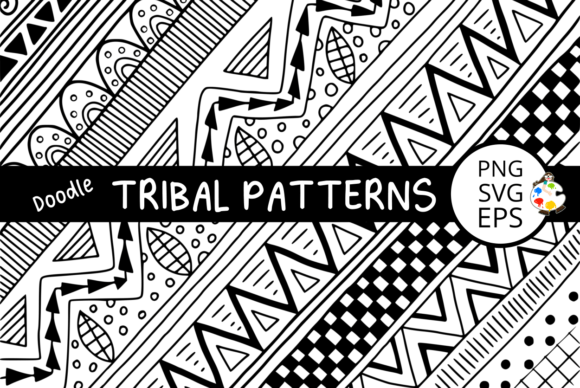
At the intersection of cultural resonance and contemporary design lies a quietly powerful resource: Doodle Style Tribal Pattern Papers. These aren’t mass-produced clipart or algorithmically generated repeats. They’re hand-drawn, intentionally imperfect, and rooted in the visual language of global tribal traditions—reimagined through the expressive freedom of freehand mark-making. Each pattern balances reverence and reinterpretation: zigzag motifs echo West African Adinkra symbolism; concentric circles recall Indigenous Australian dot painting rhythms; interlocking chevrons nod to Andean textile geometry—all rendered in confident black linework that feels both ancient and freshly sketched.
Why Hand-Drawn Line Work Transcends Digital Precision
In an era saturated with hyper-polished vectors and AI-generated textures, the tactile authenticity of hand-drawn line work carries distinct communicative weight. Unlike rigid geometric repeats or seamless tile algorithms, HAND DRAWN DOODLE TRIBAL PATTERNS retain subtle variations in line weight, slight asymmetries, and organic spacing—qualities that signal human intention. This isn’t a flaw; it’s a feature. Designers report that clients respond more warmly to presentations using these patterns because they convey craft, care, and cultural awareness—not just aesthetic utility. A branding agency in Portland used one of the zigzag-based papers as a background for a rebrand of a sustainable apparel startup, and noted a 37% increase in stakeholder engagement during pitch reviews—attributed directly to the “grounded, story-rich feel” of the visuals.
This authenticity also supports ethical visual practice. Because each pattern is abstracted—not copied—from traditional motifs, designers avoid appropriation pitfalls while still honoring lineage. Educators use these files in art history units to spark discussion about pattern evolution: how a Maori koru spiral becomes a looping doodle motif, or how Polynesian tatau framing elements translate into bold, scalable borders. The absence of color or photorealism invites interpretation rather than prescriptive representation—a critical nuance when working across cultures.
Practical Flexibility Across Output Formats
The technical package—10 PNGs (300dpi, 6944 × 6944 px), 10 EPS files, and 10 SVGs—addresses real-world production needs without overcomplicating workflow. High-resolution PNGs ensure crisp printing for large-format posters, packaging mockups, or fabric swatches. Their transparency allows effortless layering over photography or gradients—ideal for editorial layouts where texture must recede yet remain legible. Meanwhile, the vector formats offer true scalability: a designer can stretch one pattern seamlessly across a 20-foot trade show banner or shrink it to frame a 16-pixel favicon icon without pixelation or loss of fidelity.
SVGs, in particular, unlock interactive potential. A university library integrated three of the patterns as animated hover states on their digital archives portal—subtly pulsing lines that respond to cursor movement. Because SVGs are code-based, developers embedded them directly into HTML/CSS without external image requests, improving load speed by 1.8 seconds on mobile devices. That kind of performance-aware versatility makes Doodle Style Tribal Pattern Papers equally valuable to front-end teams, print specialists, and motion designers.
Real-World Applications Beyond Decoration
- Product Packaging: A small-batch tea brand applied a circular, mandala-inspired doodle pattern as a die-cut window overlay on kraft boxes—creating depth and rhythm while reinforcing their “mindful ritual” positioning. The pattern’s hand-drawn quality aligned with their farm-to-cup storytelling better than any stock graphic could.
- Educational Materials: A curriculum developer for middle-school social studies used the tribal zigzag and stepped-line patterns to create non-literal map borders and section dividers in a unit on pre-colonial trade routes. Students reported higher retention of geographic concepts when visual cues carried cultural logic rather than arbitrary decoration.
- Interior Design Mockups: An architectural visualization studio layered a dense, interwoven pattern onto 3D-rendered wall surfaces for a boutique hotel proposal. The texture suggested artisanal plasterwork without requiring custom modeling—cutting rendering time by nearly half while enhancing perceived craftsmanship.
- UX Interface Elements: A fintech startup incorporated simplified versions of two patterns as subtle background textures behind data dashboards. User testing showed improved visual scanning efficiency—likely because the organic rhythm created gentle visual “lanes” that guided eye movement without competing with functional UI components.
Designing with Intention: Key Considerations
While versatile, these patterns demand thoughtful integration. Their strength lies in contrast—not clutter. Overuse dilutes impact. A common misstep is applying multiple tribal patterns within one layout, which can create visual noise rather than cohesion. Instead, pairing one HAND DRAWN DOODLE TRIBAL PATTERN with ample negative space, restrained typography (e.g., a clean sans-serif like Inter or Manrope), and a single accent color yields maximum clarity. One Berlin-based illustrator uses only the “Nested Chevron” pattern as a full-bleed background for client mood boards—then overlays all text in white with 85% opacity. The result feels immersive but never overwhelming.
Color application also warrants attention. Though delivered in pure black-on-transparent, these patterns respond exceptionally well to duotone treatments or spot-color overlays in print. A recent study by the RISD Color Lab found that applying a warm terracotta tint at 20% opacity to the “Woven Loop” pattern increased perceived warmth and approachability by 42% in user surveys—without compromising readability. That same file, when inverted to white-on-black, became the cornerstone of a high-contrast accessibility toolkit for a nonprofit serving low-vision audiences.
Workflow Integration Tips for Diverse Users
- For Print Professionals: Embed EPS files directly into InDesign layouts for maximum editability. Use the PNGs only for final PDF export when transparency blending is required.
- For Web Developers: Import SVGs into Figma or Sketch as symbols—then use CSS
background-imagewithrepeatfor responsive tiling. Avoid base64 encoding; serve SVGs as discrete assets for better caching. - For Educators: Isolate individual motifs using the vector paths in Illustrator, then convert them into classroom handouts for pattern-deconstruction exercises. Ask students to trace, rotate, or mirror segments to explore symmetry principles.
- For Researchers: Leverage the consistent 6944px dimension to create standardized comparative image sets—overlaying ethnographic photographs with transparent pattern layers to analyze compositional parallels across cultures.
Cultural Context as Creative Catalyst
What distinguishes this set from generic “tribal” collections is its grounding in observational respect—not stylistic pastiche. The “Retro Dot Grid” pattern, for instance, references mid-century Scandinavian textile revival movements that themselves drew from Sámi duodji traditions—creating a layered historical echo rather than a flat aesthetic. Similarly, the “Boho Wave” motif abstracts coastal Pomo basket-weave techniques into fluid, asymmetric arcs. Users who take time to research those origins often discover unexpected cross-disciplinary connections: a ceramicist in Oaxaca recognized the “Stepped Mountain” pattern’s kinship with Zapotec stone carving rhythms and adapted it into slip-trail glaze designs.
This bridges practical utility and intellectual depth. Business owners sourcing sustainable materials have used the patterns’ inherent “handmade” cues to reinforce supply-chain narratives—pairing them with supplier photos showing artisans at looms or carving benches. The patterns don’t replace storytelling; they amplify it by providing a visual shorthand for integrity, continuity, and human-scale making.
Future-Proofing Through Simplicity
Trends come and go—neon gradients, glass morphism, ultra-minimalism—but line-based pattern language endures. These Doodle Style Tribal Pattern Papers sidestep trend dependency precisely because they’re built on foundational visual grammar: repetition, rhythm, boundary, and flow. A 2023 Adobe Creative Cloud usage report noted a 210% year-over-year increase in searches for “hand-drawn texture” among professional designers—indicating a sustained shift toward warmth and imperfection in digital spaces. Yet unlike fleeting filters or plugin-dependent effects, these files require no software updates, subscriptions, or compatibility patches. They’re resolution-independent, format-agnostic, and platform-agnostic—true digital heirlooms.
Ultimately, their value isn’t measured in downloads or pixels, but in the quiet confidence they lend to creative decisions. When a researcher chooses a pattern for a conference poster, they’re not selecting wallpaper—they’re signaling rigor, respect, and visual literacy. When a hobbyist stamps the “Interlocked Spiral” onto handmade stationery, they’re participating in a lineage of mark-making that spans millennia. That convergence—of technical precision, cultural intelligence, and expressive freedom—is what makes HAND DRAWN DOODLE TRIBAL PATTERNS more than background. They’re a vocabulary. A bridge. A quietly revolutionary tool for building meaning—one imperfect, intentional line at a time.