Spring Floral Pattern: A Versatile Digital Design Resource for Creative Professionals and Makers
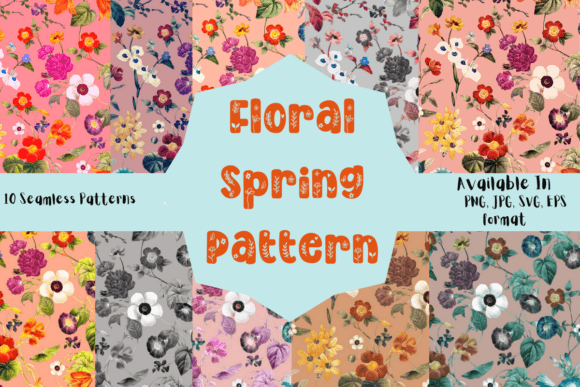
Spring floral pattern evokes renewal, softness, and organic rhythm—qualities that resonate across disciplines, from interior design and textile development to education and digital illustration. Unlike seasonal trends that fade quickly, a well-crafted spring floral pattern carries timeless compositional logic: balanced asymmetry, layered petal forms, rhythmic stem curvature, and harmonious color transitions rooted in nature’s palette. When delivered as a high-fidelity digital asset bundle—ten distinct patterns, each scalable and format-rich—it becomes more than decoration. It becomes infrastructure for creation.
Why Ten Patterns Matter More Than You Might Expect
Quantity alone doesn’t define value—but intentionality behind variety does. This collection isn’t ten variations of the same motif repeated with minor hue shifts. Instead, it offers deliberate diversity in scale, density, structure, and botanical reference:
- Micro-scale patterns (under 1.5 inches repeat) optimized for delicate applications like stationery, fabric swatches, or embroidery guides;
- Medium-repeat motifs (4–8 inches), ideal for upholstery, pillow covers, and wallpaper mockups where continuity and visual rest are equally important;
- Large-scale, directional arrangements suited for rugs, floor decals, or wall murals where flow and movement guide the eye across space;
- Botanically grounded variants—some inspired by cherry blossoms’ airy clusters, others echoing daffodil symmetry or hyacinth verticality—giving designers biological authenticity without sacrificing stylization;
- Abstracted interpretations that retain floral essence while simplifying form for modern branding, app interfaces, or minimalist interiors.
This range reflects how real-world projects unfold: a textile designer may need tight repeats for quilting cotton, while an educator preparing science visuals benefits from clearly legible, labeled botanical structures. A business owner launching eco-conscious packaging might select a pattern with muted greens and chalky pinks to signal sustainability—not just seasonality.
Format Flexibility Enables Real-World Workflow Integration
The inclusion of JPG, PNG, SVG, and EPS files at 5000px × 5000px and 300 dpi isn’t a technical afterthought—it’s workflow insurance. Each format serves a distinct functional role:
- JPG delivers fast previewing, email sharing, and web-based mood board assembly—especially useful for collaborative client reviews or classroom presentations;
- PNG provides transparency support essential for overlaying patterns onto product mockups (e.g., applying a floral motif to a 3D-rendered cushion or ceramic mug);
- SVG ensures crisp rendering at any size in web environments—think animated background textures on portfolio sites or responsive pattern tiles in digital learning platforms;
- EPS preserves vector integrity for professional print production, allowing seamless integration into Adobe Illustrator workflows for large-format printing, signage, or custom fabric dyeing specifications.
Because all files share identical dimensions and resolution, switching between formats introduces no scaling surprises or quality loss—a critical advantage when iterating across physical and digital outputs. For example, a maker designing laser-cut wooden coasters can import the SVG directly into LightBurn; later, the same pattern—exported as PNG—can populate an Etsy listing banner without resampling artifacts.
Practical Applications Across Disciplines
What makes spring floral pattern especially valuable is its adaptability beyond expected contexts. Consider these less obvious but highly effective uses:
Educational Tools and Visual Literacy Development
Teachers use floral motifs to teach symmetry, tessellation, and proportion in mathematics units. Biology educators overlay annotated versions of these patterns to demonstrate inflorescence types (racemes vs. corymbs) or pollination pathways. The consistent 5000px canvas allows zooming into individual petals during interactive whiteboard sessions—no pixelation, no distortion.
Sensory-Informed Environments
Occupational therapists and special education professionals incorporate spring floral pattern into sensory rooms or calming corners. Research suggests that gently repeating natural motifs reduce cognitive load and support emotional regulation. High-resolution files enable precise printing on acoustic panels, weighted blanket overlays, or tactile wall decals—where clarity of line and color fidelity directly impact therapeutic efficacy.
Small-Business Brand Cohesion
A local florist, bakery, or wellness studio can unify their identity using one core pattern across multiple touchpoints: letterhead (JPG), reusable tote bags (SVG for screen printing), social media highlight icons (PNG with transparency), and seasonal window decals (EPS for vinyl cutting). Because all ten patterns share a cohesive chromatic language—soft sage, petal pink, warm ivory, and muted sky blue—they offer flexibility without visual fragmentation.
Prototyping and Client Communication
Interior designers often face the “abstract description gap”: clients struggle to imagine how a pattern translates across surfaces and lighting conditions. With this bundle, designers embed actual pattern files into 3D room visualizations (using tools like SketchUp + V-Ray or Enscape), adjusting scale and orientation in real time. No more vague references to “something light and airy”—just accurate, photoreal previews that accelerate approval cycles.
Technical Considerations That Impact Long-Term Usability
While aesthetics draw initial attention, durability in application depends on underlying technical choices. These patterns were developed with practical constraints in mind:
- No embedded fonts or external links: All text elements (if present in editable layers) are outlined or rasterized—eliminating missing-font errors in cross-platform editing;
- CMYK-safe palettes: Though RGB-native for screen use, colors fall within standard coated and uncoated SWOP gamuts, ensuring predictable results when converted for commercial offset printing;
- Non-destructive layer organization (in layered source files, where applicable): Petals, stems, and background elements reside on separate layers, enabling quick recoloring or selective removal without affecting structural integrity;
- No proprietary plugins or effects: Patterns avoid gradient meshes, complex blends, or dynamic filters that may not render consistently across software versions or devices.
Such considerations prevent common pitfalls: a craft entrepreneur discovering too late that a “floral” download contains only low-res Instagram posts; a university lab technician unable to extract clean vectors for CNC routing; or a nonprofit team struggling to adapt a pattern for accessible print materials due to insufficient contrast or uneditable text.
Thinking Beyond Decoration: Pattern as Functional Language
At its most effective, spring floral pattern operates not as ornament but as communicative shorthand. In healthcare settings, subtle floral repeats on waiting room walls have been associated with reduced perceived wait times. In retail, coordinated patterns across shelf liners, bag inserts, and receipt paper reinforce brand memory through environmental consistency. In urban planning, floral motifs appear in wayfinding systems for community gardens or green corridors—linking human navigation with ecological context.
This functional dimension explains why educators, researchers, and policy designers increasingly treat pattern libraries as civic assets—not just creative resources. A city’s public art initiative might license a spring floral pattern for bus shelter wraps, then release derivative versions under open licenses for neighborhood co-design workshops. The scalability and format breadth ensure equitable access: students with older laptops run PNG previews; municipal printers output EPS for durable street banners; community centers edit SVGs in free browser-based tools like Vectr.
Getting Started Without Overwhelm
With ten options and four formats, initiation can feel daunting. Here’s a pragmatic entry sequence:
- Identify your primary output medium first—is it physical (fabric, paper, wood) or digital (web, presentation, video)? That determines your starting format (EPS/JPG for print; SVG/PNG for screen).
- Match scale to surface size: Small items (<6") usually benefit from micro or medium repeats; large walls or floors demand larger-scale motifs to avoid visual noise.
- Test contrast and legibility early: Import your chosen file into the actual software you’ll use for final output—even if it’s just placing the PNG over a photo of your intended backdrop.
- Reserve one pattern as your “anchor”—the version you return to for color matching, branding alignment, or client sign-off—then explore variations from that baseline.
No physical product ships because the value resides entirely in reproducible, adaptable information—not material scarcity. That aligns with evolving creative economies where speed, customization, and sustainability matter more than inventory. Whether you’re drafting lesson plans, developing a product line, prototyping spatial experiences, or supporting neurodiverse learners, this spring floral pattern bundle functions as reliable, ethically sourced, technically sound raw material—ready for your next meaningful iteration.